AIA change order form (G701): the five lines, worked through three change orders
The AIA change order form, G701, records an agreed change in five contract-sum lines — original sum, net change by earlier change orders, sum before this change, this change, new sum — plus the change in contract time and the new date of Substantial Completion, signed by the owner, architect and contractor.
The form is short on purpose. It does not price the work: AIA’s G701–2017 instructions ask for “a detailed description of the change” or a reference to exhibits, then five amounts and a time adjustment. The value is in how the five lines chain from one change order to the next, so this page follows one fictional job through three of them.
The five lines and the time block
| Line | What goes in it | Clinic job, CO-003 |
|---|---|---|
| 1 | Original Contract Sum (or Guaranteed Maximum Price) | $486,500.00 |
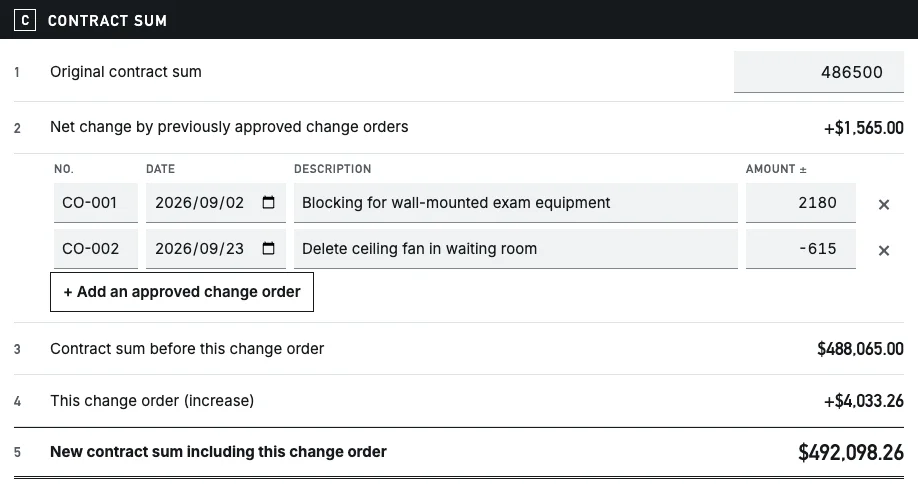
| 2 | Net change by previously authorized change orders | +$1,565.00 |
| 3 | Contract Sum prior to this change order (1 + 2) | $488,065.00 |
| 4 | Increase or decrease by this change order | +$4,033.26 |
| 5 | New Contract Sum including this change order (3 + 4) | $492,098.26 |
| Time | Change in Contract Time, in days, and the new date of Substantial Completion | +4 days; Jan 15, 2027 → Jan 19, 2027 |
One job, three change orders
The clinic fit-out starts at $486,500.00. Three changes are agreed in order. Each row below is what that change order’s five lines say on the day it is signed:
| Change order | Line 1 | Line 2 | Line 3 | Line 4 | Line 5 |
|---|---|---|---|---|---|
| CO-001 Blocking for wall-mounted exam equipment | $486,500.00 | ±$0.00 | $486,500.00 | +$2,180.00 | $488,680.00 |
| CO-002 Delete ceiling fan in waiting room | $486,500.00 | +$2,180.00 | $488,680.00 | −$615.00 | $488,065.00 |
| CO-003 Flooring, circuits, paint credit | $486,500.00 | +$1,565.00 | $488,065.00 | +$4,033.26 | $492,098.26 |
Two things stay true on every row, and they are the fastest way to check a stack of change orders without opening the cost backup:
- Line 1 never changes. It is the sum in the signed agreement. If a later change order shows a different line 1, someone has rolled an earlier change into it and line 2 will double count.
- Line 3 of each change order equals line 5 of the one before. $488,680.00 on CO-002 is CO-001’s line 5; $488,065.00 on CO-003 is CO-002’s. A gap means a change order is missing from line 2, or one was counted that was never authorized.
A credit works the same way. CO-002 deletes a ceiling fan for −$615.00, so line 2 on CO-003 is +$2,180.00 − $615.00 = +$1,565.00, not the sum of the absolute values.
The directive that is not in line 2 yet
Suppose the architect had also issued a Construction Change Directive in early October for, say, $6,200 of added fire-stopping while the price was still disputed. AIA’s instructions are explicit that line 2 counts changes by previously authorized change orders and does not include changes made by directive unless the contractor later agreed and they were recorded as a change order.
So CO-003 still shows +$1,565.00 on line 2. If the directive were added there, line 3 would read $494,265.00 and would no longer match CO-002’s line 5 of $488,065.00 — the check above catches it. The G714 instructions describe the route back: once the owner and contractor agree on the adjustment, the architect prepares a change order for it, and only then does it join line 2. The construction change directive guide follows one directive from the field to its change order.
Days, not just a new date
G701 asks for the change in Contract Time in days and the date of Substantial Completion after the adjustment. Writing both lets the owner check one against the other. G701 itself has no box for the contract time before the change; Renpavo’s form adds one. In the clinic example that is 150 calendar days, the change adds 4, and the form shows 150 + 4 = 154 days and moves the completion date from January 15 to January 19, 2027. If a later change order shows a date that does not equal the previous date plus its own days, a time extension was missed or counted twice — the same chain test as line 3.
Where the cost breakdown goes
Line 4 is one number. The quantities, unit prices, markup and tax behind it belong in the description or an attached exhibit. The clinic’s +$4,033.26 is $5,149.00 of added work, $1,648.00 of credits, $420.12 markup and $112.14 tax; Part B of the form prints that breakdown on the same pages as the five lines, so the exhibit cannot get separated from the summary.
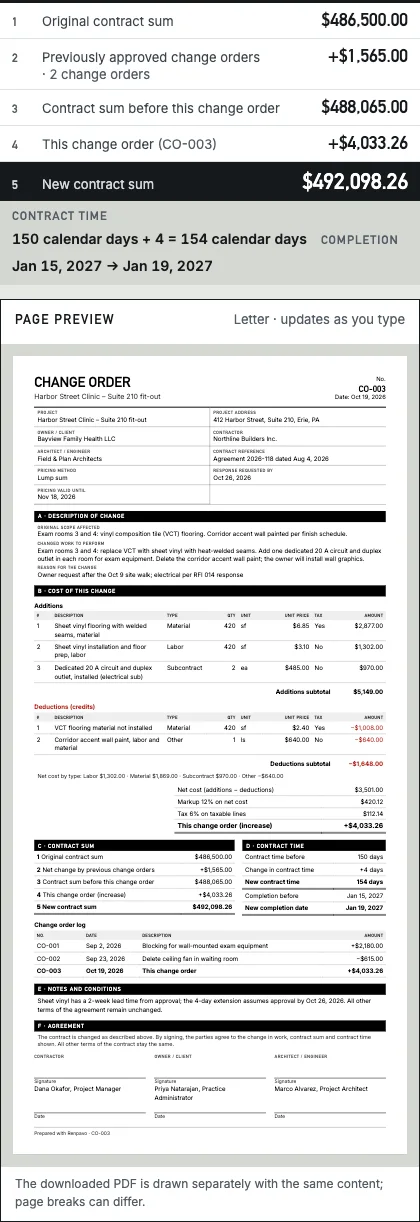
If your contract names G701, buy and use it; AIA’s instructions also note the forms may need changes to comply with state or local law. If it does not, the five-line structure is still worth copying, because owners who use AIA contracts already read change orders in that order. The change order form fills in lines 2–5 from the earlier change orders you list.
Questions
Is the AIA G701 form free?
No. AIA sells G701–2017 as a licensed document; its instructions page links to a one-time license and a subscription. The five-line summary itself is arithmetic you can show on any change order your contract allows; Renpavo is an independent form, not an AIA document.
Can a G701 change only the contract time?
Yes. The instructions ask for the increase or decrease in the contract sum “if any” and the same for contract time, so a time-only change shows ±$0.00 on line 4 and the added days in the time block. In Renpavo, choose “No change in price” as the pricing method.
Who signs a G701 change order?
The owner, the architect and the contractor. AIA’s instructions say to execute it once the owner and contractor, in concurrence with the architect, have agreed on the change, including the contract sum and time.
Sources
- AIA Contract Documents, “Instructions: G701–2017, Change Order”
- AIA Contract Documents, “Instructions: G714–2017, Construction Change Directive”
Sources opened on October 29, 2026. All amounts on this page are calculated from the example change orders; percentages are taken from the cited source or stated as an example, not as a recommended rate.
More change order guides
- Change order request vs. change orderWho starts each document, whether it changes the contract, and the same clinic change written both ways.
- Change order log template with a running contract sumExcel log where status decides what moves the contract sum; worked through a fire station job.
- Deductive change orders: does the credit carry markup?A value-engineering swap priced with markup on the net and on additions only — and why the gap is 10% of the credit.
- Construction change directive (CCD): what it is and how the work gets pricedDirected rock removal priced afterwards: one flat markup gives $9,499.00, Caltrans-style markups by cost type give $10,293.96 against a $9,500 cap.
- Change order template: blank Word, PDF and Excel formsFree fill-by-hand form in Letter, A4 and Word, with the six arithmetic checks a hand-filled change order needs.