Construction change directive (CCD): what it is and how the work gets priced
A construction change directive (CCD) is a written order that makes the contractor carry out a change before the price or time adjustment is agreed. In AIA contracts it is prepared by the architect and authorized by the owner, the contractor must proceed, and the adjustment is settled afterwards, when the change is recorded as a change order.
When a directive is used instead of a change order
AIA’s G714 instructions describe the situation precisely: the owner and contractor have not agreed on the change in contract sum or time, and the change, “if not expeditiously implemented, might delay the project”. A change order needs that agreement first; a directive lets the work start without it. The price question does not go away: unless a lump sum is agreed at once, it is usually settled after the work, when the actual hours and quantities are known.
| Construction change directive (G714) | Change order (G701) | |
|---|---|---|
| Who signs | Architect, then the owner (or a representative with enough spending authority) | Owner, architect and contractor |
| Contractor’s agreement | Not required to start; the contractor must proceed | Required: it records what was agreed |
| Price and time | A proposed method or amount, which may be disputed | Agreed amounts on line 4 and in the time block |
| Effect on the contract sum | Not counted in G701 line 2 until agreed and recorded as a change order (G701 instructions) | Moves the contract sum when signed |
G714 also limits who can authorize it: the architect alone cannot authorize extra cost or time, and the owner’s representative must be empowered to authorize the funds, with the amount within that person’s monetary authority.
How the adjustment is settled afterwards
- The directive proposes a method. G714 offers a lump sum (when the total is likely to be agreed), unit prices (when the unit cost is agreed but the quantity is not), or the cost of the work plus a fee, the AIA method closest to time and materials.
- The contractor accepts or objects. If it accepts, that method is used for later payment applications. If not, the method in A201–2017 section 7.3.4 applies.
- Undisputed amounts can be billed before the dispute ends. G714 notes they may be included in applications for payment, documented by written agreement using G702.
- A change order closes it. The architect prepares a change order when the contractor agrees to the proposed adjustment on receipt, or when the owner and contractor agree to the architect’s determination under A201–2017 section 7.3.10. Without agreement after that determination, the matter is referred to the Initial Decision Maker as a Claim.
Worked example: rock at footing F-7
A fire-station contractor hits rock at footing F-7, below the elevation the bid assumed. The foundation crew cannot wait, so the architect issues a directive, authorized by the owner: remove the rock on a cost-plus-fee basis, not to exceed $9,500.00. Two days of signed tickets add up to these costs before markup:
| Cost | Calculation | Amount | Type |
|---|---|---|---|
| Operator, excavator with hydraulic breaker | 16 hr × $92.50 | $1,480.00 | Labor |
| Laborers (2) | 32 hr × $61.00 | $1,952.00 | Labor |
| Excavator with hydraulic breaker | 16 hr × $185.00 | $2,960.00 | Equipment |
| Rented tandem dump truck with driver (not owner-operated), haul off | 8 hr × $118.00 | $944.00 | Equipment |
| Structural fill, delivered | 24 cy × $38.50 | $924.00 | Material |
| Total cost | $8,260.00 |
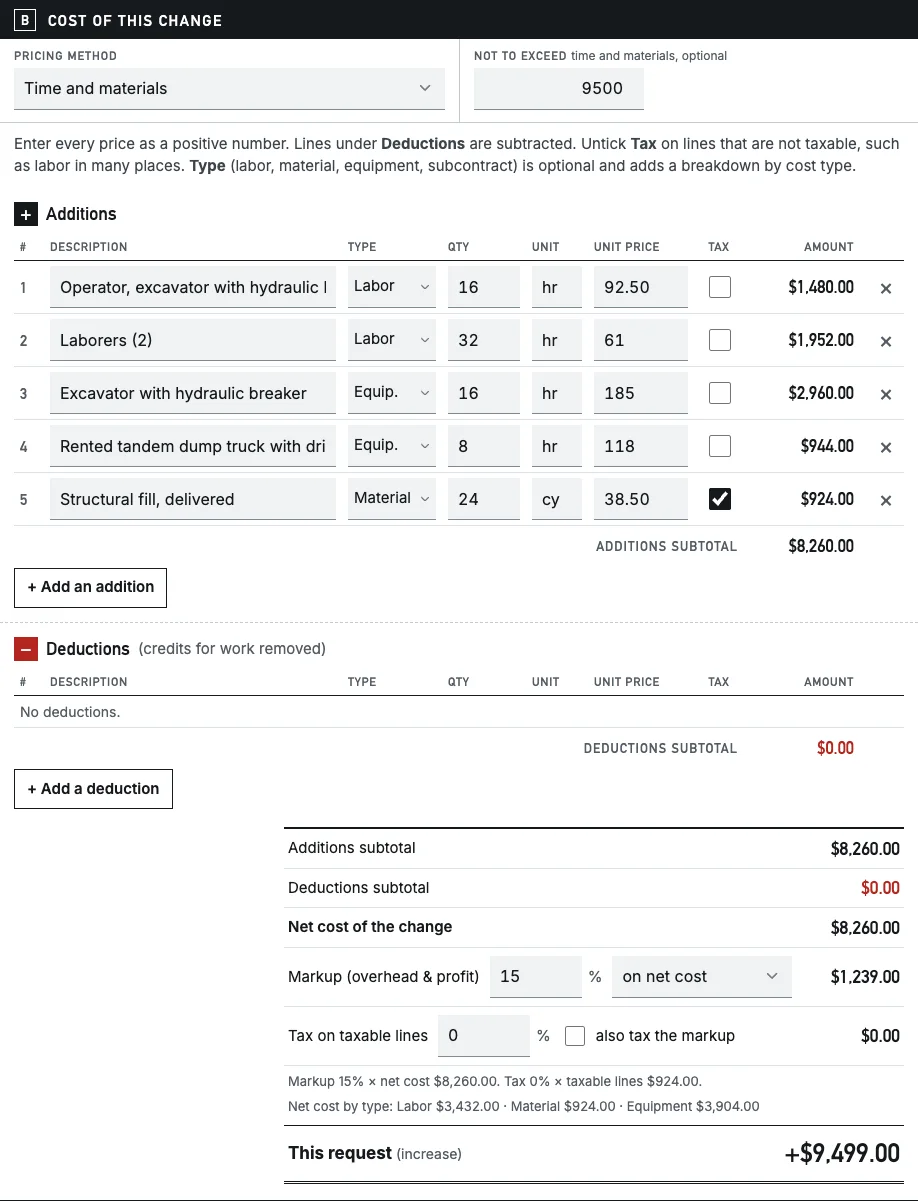
With an assumed single 15% fee the price is $8,260.00 + $1,239.00 = $9,499.00, one dollar under the cap.
The same tickets with markups by cost type
A contract can instead set a different markup for each cost type. Caltrans’ 2025 Standard Specifications, section 9-1.04 (printed pages 130–133), is a public example for work paid by force account: 35% on labor, 15% on materials, 15% on equipment rental, and an additional 10% on the total, markups included, when a subcontractor performs the work. The specification says these markups cover delay costs, overhead and profit, and it sets lower ones (30/10/10) for non-subcontracted work on contracts with a TRO bid item. It treats a non-owner-operated dump truck — rented with its driver — as rental equipment whose owner is a subcontractor for markup purposes, while owner-operated labor and equipment are paid at the market-priced invoice. The truck here is rented, so it takes both markups:
| Cost type | Cost | Markup | Calculation |
|---|---|---|---|
| Labor | $3,432.00 | $1,201.20 | 35% × $3,432.00 |
| Excavator with breaker | $2,960.00 | $444.00 | 15% × $2,960.00 |
| Rented dump truck with driver | $944.00 | $250.16 | 15% × $944.00 = $141.60, then 10% × $1,085.60 = $108.56 |
| Structural fill | $924.00 | $138.60 | 15% × $924.00 |
| Total | $8,260.00 | $2,033.96 |
Total: $8,260.00 + $2,033.96 = $10,293.96, $793.96 over the cap. The blended rate is $2,033.96 ÷ $8,260.00 = 24.6242%, well above 15%, because labor — the type with the highest markup — is 42% of the cost.
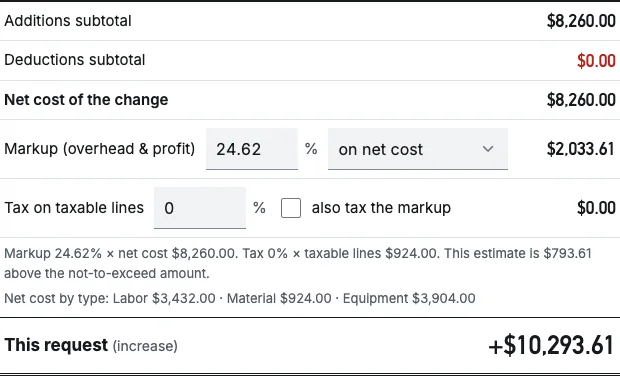
Entered as 24.62% in the form, the markup is $2,033.61 and the total $10,293.61, $0.35 below the exact figure because the rate is rounded to two decimals; the form then flags the not-to-exceed amount.
Does the cap limit cost or price?
“Not to exceed $9,500.00” can be read two ways. As a cap on cost, the F-7 work fits: $8,260.00 of tickets is $1,240.00 under it, and the markups are paid on top for $10,293.96. As a cap on price, the same tickets exceed it by $793.96. State in the directive or the first request which one is meant, and set the figure after estimating the markups.
From directive to change order
When the tickets are complete, the contractor prices them on a change order request — in Renpavo, Document set to request and pricing method set to time and materials — and the agreed figure becomes a change order. Until then the directive stays out of line 2: on this job the next change order still shows the contract sum before the rock work, and the change order log carries it as pending.
Checklist when working under a directive
- Confirm the person who signed for the owner can authorize the amount.
- Answer the proposed method of adjustment in writing, accepting it or saying why not.
- Keep daily tickets of labor, equipment and material, signed by the owner’s representative.
- State whether the not-to-exceed amount caps cost or price, and the markup for each cost type.
- Include undisputed amounts in the next pay application by written agreement; close the rest with a change order.
Questions
What does CCD stand for in construction?
Construction change directive. In AIA’s documents it is form G714–2017, used “where the owner and contractor have not agreed on proposed changes in the contract sum or contract time” (AIA G714 instructions).
Does the contractor have to do the work if it disagrees with the price?
Under AIA G714, yes: on receipt the contractor “shall promptly proceed”. If the proposed method of adjustment is not acceptable, the contractor tells the architect and the method designated in A201–2017 section 7.3.4 applies; if there is still no agreement after the architect’s determination, the matter becomes a Claim. Your own contract decides how this works on your job.
What markup applies to work done under a directive?
Whatever the contract sets for changed work. One published example of markups by cost type is Caltrans’ 2025 Standard Specifications, section 9-1.04: 35% on labor, 15% on materials and 15% on equipment rental, plus 10% on the total, markups included, when a subcontractor performs the work (Caltrans 2025 Standard Specifications).
Sources
- AIA Contract Documents, “Instructions: G714–2017, Construction Change Directive”
- AIA Contract Documents, “Instructions: G701–2017, Change Order”
- California Department of Transportation, 2025 Standard Specifications, section 9-1.04 Force Account (pages 130–133)
Sources opened on October 29, 2026. All amounts on this page are calculated from the example change orders; percentages are taken from the cited source or stated as an example, not as a recommended rate.
More change order guides
- AIA change order form (G701): the five lines, worked through three change ordersLine by line through CO-001, CO-002 and CO-003 on one job, and the check that catches a wrong line 2.
- Change order request vs. change orderWho starts each document, whether it changes the contract, and the same clinic change written both ways.
- Change order log template with a running contract sumExcel log where status decides what moves the contract sum; worked through a fire station job.
- Deductive change orders: does the credit carry markup?A value-engineering swap priced with markup on the net and on additions only — and why the gap is 10% of the credit.
- Change order template: blank Word, PDF and Excel formsFree fill-by-hand form in Letter, A4 and Word, with the six arithmetic checks a hand-filled change order needs.