Change order template: blank Word, PDF and Excel forms
Download a blank construction change order template as an editable Word file or a PDF for US Letter or A4, plus an Excel change order log. It has the project and parties, a description of the change, separate tables for additions and deductions, the five contract-sum lines, contract time and three signature blocks.
- Blank change order form, PDF (US Letter)
- Blank change order form, PDF (A4)
- Blank change order form, Word (.docx)
- Change order log, Excel (.xlsx)
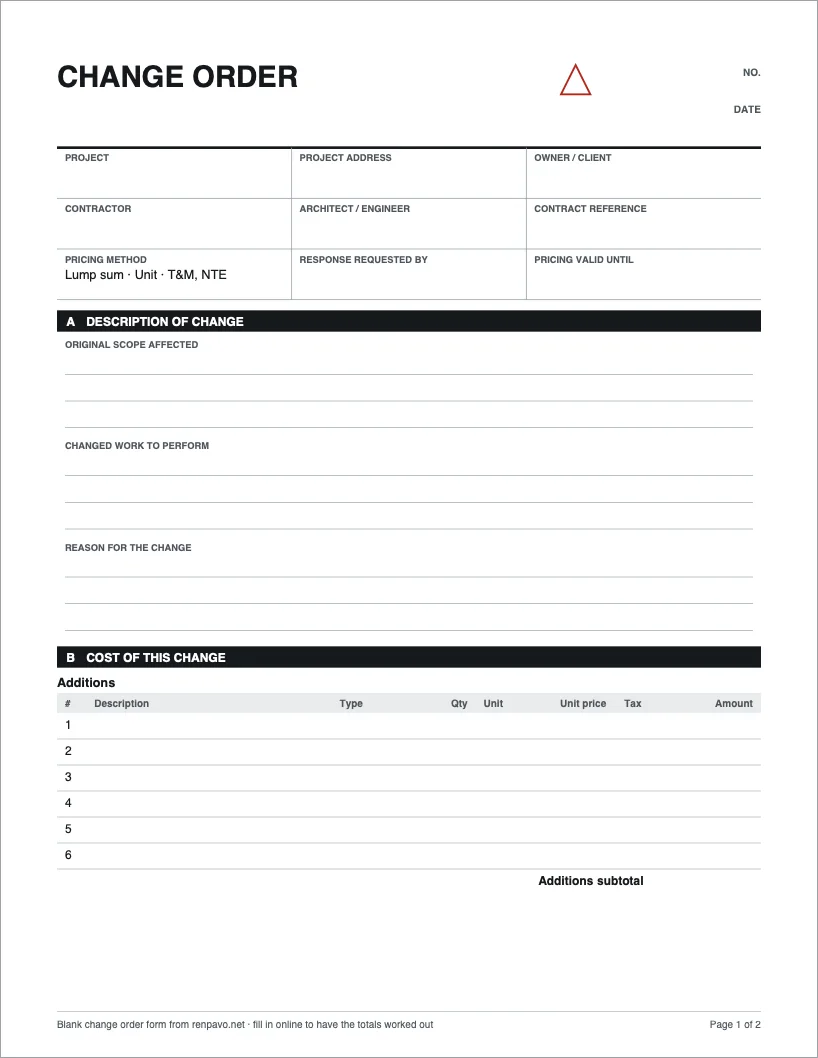
What goes in each section
| Section | Fill in | Tip |
|---|---|---|
| Header and grid | Number, date, project, address, owner, contractor, architect, contract reference, pricing method, response date, validity date | Number change orders in one series per contract: CO-001, CO-002… |
| A · Description | Original scope affected, changed work to perform, reason | Name locations, quantities and drawing or RFI references |
| B · Additions | Each added item: description, type, quantity, unit, unit price, tax, amount | One line per cost; no lump “extras” |
| B · Deductions | Each removed item, written as a positive price | Never net a credit into an added line |
| Cost summary | Net cost, markup % and its basis, tax %, this change order | Circle “net cost” or “additions only” for the markup |
| C · Contract sum | Lines 1–5 | Line 3 = line 5 of the previous change order |
| D · Contract time | Days before, change in days, new total, completion dates | Calendar days unless the contract says otherwise |
| E · Notes and conditions | Lead times, assumptions, exclusions, references to attachments | Say what the price and the extra days depend on |
| F · Agreement | Names, titles, signatures, dates | Three blocks; strike the architect block if there is none |
Six arithmetic checks for a hand-filled form
A blank form leaves the arithmetic to you. Six checks cover every calculated box, shown with the numbers from the clinic example:
- Each line amount = quantity × unit price: 420 sf × $6.85 = $2,877.00.
- Net cost = additions − deductions: $5,149.00 − $1,648.00 = $3,501.00.
- Markup on the stated basis: 12% × $3,501.00 = $420.12.
- Tax, where it is charged separately, on taxable lines only, credits included: 6% (an illustrative rate) × ($2,877.00 − $1,008.00) = $112.14.
- This change order = net cost + markup + tax = +$4,033.26, written again as line 4.
- Line 5 = line 3 + line 4: $488,065.00 + $4,033.26 = $492,098.26; and line 3 equals line 5 of the previous change order.
If you would rather not do these by hand, the online change order form does them as you type and prints the same layout. The markup basis in check 3 is the decision that moves the most money on credits; the deductive change order guide shows why.
Editing the Word version
The .docx uses plain tables, so rows can be added in Word, Google Docs, Pages or LibreOffice without breaking the layout. Keep the five contract-sum lines together on one page; an owner reading a change order looks for them first. When the job has several change orders, keep the change order log beside the forms so line 2 on each new form can be copied from it.
Questions
Is the PDF fillable on screen?
No, it is a print-and-write form. To type into it, use the Word version, or fill in the online form, which also calculates the totals and downloads a PDF.
Is this template an AIA G701?
No. It follows the same five-line contract-sum summary that AIA’s G701 instructions describe, but it is an independent Renpavo form. If your contract requires the AIA document, use that (AIA G701 instructions).
Can I add my logo?
In the Word version, insert it in the header. The online form takes a logo image and prints it on the PDF.
Sources
Sources opened on October 29, 2026. All amounts on this page are calculated from the example change orders; percentages are taken from the cited source or stated as an example, not as a recommended rate.
More change order guides
- AIA change order form (G701): the five lines, worked through three change ordersLine by line through CO-001, CO-002 and CO-003 on one job, and the check that catches a wrong line 2.
- Change order request vs. change orderWho starts each document, whether it changes the contract, and the same clinic change written both ways.
- Change order log template with a running contract sumExcel log where status decides what moves the contract sum; worked through a fire station job.
- Deductive change orders: does the credit carry markup?A value-engineering swap priced with markup on the net and on additions only — and why the gap is 10% of the credit.
- Construction change directive (CCD): what it is and how the work gets pricedDirected rock removal priced afterwards: one flat markup gives $9,499.00, Caltrans-style markups by cost type give $10,293.96 against a $9,500 cap.