Change order request vs. change order
A change order request is the contractor’s priced proposal asking the owner to approve a change; a change order is the signed agreement that actually adjusts the contract sum and time. Two other documents sit around them: a proposal request asks the contractor for a price, and a construction change directive orders the work before the price is agreed.
Four documents, compared
| Document | Who starts it | What it does | Changes the contract sum? |
|---|---|---|---|
| Proposal request (AIA G709) | Architect, for the owner | Describes a possible change and asks the contractor for its cost and time within a set number of days | No — AIA: “The form does not modify the contract for construction.” |
| Change order request (often COR or PCO) | Contractor | Prices the change and asks for approval by a date | Not until the owner accepts it |
| Change order (AIA G701) | Drafted by either side; signed by owner, architect and contractor | Records the agreed change in work, sum and time | Yes, on signature |
| Construction change directive (AIA G714) | Architect, authorized by the owner | Orders the work to proceed while the price or time is still disputed | Not yet; a change order follows once the adjustment is agreed |
The sequence is usually proposal request → change order request → change order. A construction change directive is the detour when the work cannot wait for agreement: AIA’s G714 instructions say the contractor “shall promptly proceed with the changes directed”, and that the architect prepares a change order when the owner and contractor agree on the adjustment.
The same change, written both ways
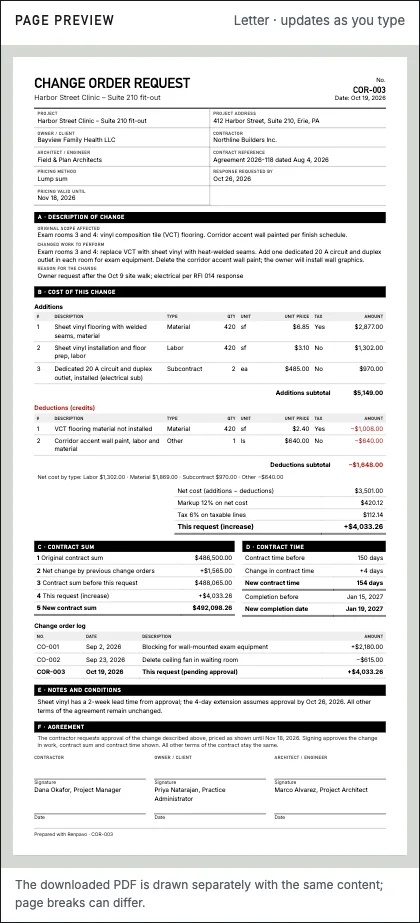
The clinic change from the worked example — sheet vinyl in two exam rooms, two dedicated circuits, a paint credit — starts as a request. In Renpavo the only difference is the Document selector at the top of the form:

What changes on the page:
- The title reads Change order request. The number does not change by itself; many teams rename it (here COR-003) and give the approved version a CO number.
- The agreement paragraph says the contractor requests approval of the change, priced as shown until the “pricing valid until” date (here November 18, 2026), instead of saying the contract is changed.
- The cost summary and line 4 say “this request”. In the change order log, the row is marked pending approval.
What stays the same: every amount. The request and the later change order both show $3,501.00 net cost, $420.12 markup, $112.14 tax and +$4,033.26 on line 4. The owner approves exactly the numbers that will later be signed.
Why a request needs two dates
The clinic request says “response requested by October 26” and “pricing valid until November 18”. They do different jobs. The response date protects the schedule: the notes explain that sheet vinyl has a two-week lead time, so the 4-day extension only holds if approval arrives by October 26. The validity date protects the price: if the owner signs in December, the contractor is not bound to October’s material quotes. A G709 proposal request has a similar clock in the other direction — AIA’s G709 FAQ notes the architect specifies the number of days within which the contractor must submit its proposal.
Pending requests and the contract sum
A request never belongs in line 2 of a change order. Line 2 is the net change by previously authorized change orders (G701 instructions). Track open requests in the same log as change orders, with a status, and total them separately — the change order log template does exactly that, so pending exposure is visible without inflating the contract sum.
Questions
Does a signed change order request change the contract?
It depends on your contract’s change procedure: it may accept an owner-signed request as the change order or require a separate change order document. Renpavo’s request wording says that signing approves the change in work, sum and time shown, so read your contract’s change clause before using it as the final document.
Can the price change between the request and the change order?
Yes. Prices in a request are an offer, which is why the request carries a “pricing valid until” date. If approval comes later, update the prices, issue a revised request (for example COR-003R1), and only then write the change order.
Is a proposal request the same as a change order request?
No. In AIA’s documents the proposal request (G709) goes from the architect to the contractor to obtain a price; AIA states it “does not modify the contract”. The contractor’s answer to it is the priced proposal, which many teams call the change order request.
Sources
- AIA Contract Documents, “FAQs: G709–2018, Proposal Request”
- AIA Contract Documents, “Instructions: G714–2017, Construction Change Directive”
- AIA Contract Documents, “Instructions: G701–2017, Change Order”
Sources opened on October 29, 2026. All amounts on this page are calculated from the example change orders; percentages are taken from the cited source or stated as an example, not as a recommended rate.
More change order guides
- AIA change order form (G701): the five lines, worked through three change ordersLine by line through CO-001, CO-002 and CO-003 on one job, and the check that catches a wrong line 2.
- Change order log template with a running contract sumExcel log where status decides what moves the contract sum; worked through a fire station job.
- Deductive change orders: does the credit carry markup?A value-engineering swap priced with markup on the net and on additions only — and why the gap is 10% of the credit.
- Construction change directive (CCD): what it is and how the work gets pricedDirected rock removal priced afterwards: one flat markup gives $9,499.00, Caltrans-style markups by cost type give $10,293.96 against a $9,500 cap.
- Change order template: blank Word, PDF and Excel formsFree fill-by-hand form in Letter, A4 and Word, with the six arithmetic checks a hand-filled change order needs.