Deductive change orders: does the credit carry markup?
A deductive change order reduces the contract sum because removed work (credits) outweighs added work. The amount depends on one decision your contract should answer before anyone prices it: whether overhead and profit come back with the credit or only apply to added work.
The example: a value-engineering swap
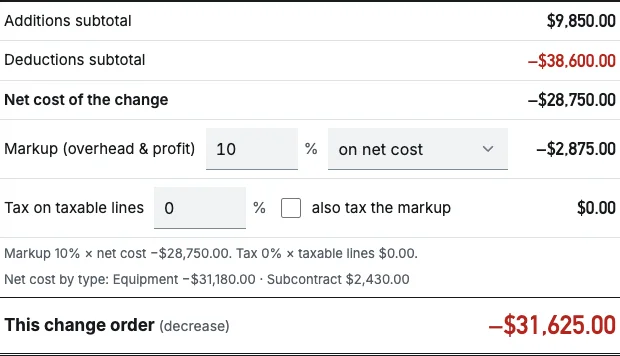
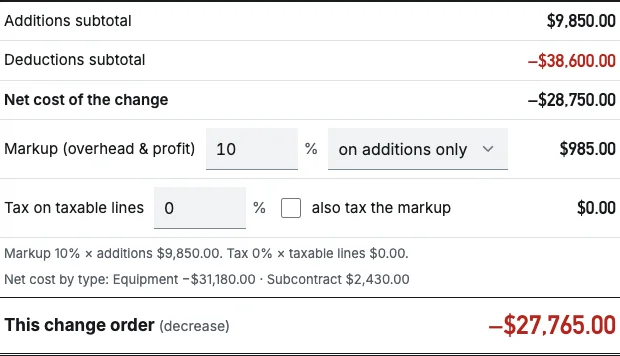
On a branch library’s HVAC contract (original sum $2,140,000.00), the owner accepts the contractor’s value-engineering proposal VE-04: delete an energy recovery ventilator and install an exhaust fan with a damper and building-automation points instead. The contract allows 10% markup on changes. The lines are the same in both versions below; only the markup basis differs.

| Markup on net cost | Markup on additions only | |
|---|---|---|
| Additions (EF-5 $7,420 + BAS $2,430) | $9,850.00 | $9,850.00 |
| Deductions (ERV-2) | −$38,600.00 | −$38,600.00 |
| Net cost | −$28,750.00 | −$28,750.00 |
| Markup 10% | −$2,875.00 (10% × −$28,750.00) | +$985.00 (10% × $9,850.00) |
| This change order | −$31,625.00 | −$27,765.00 |
| New contract sum | $2,126,775.00 | $2,130,635.00 |
The gap is $3,860.00, which is exactly 10% of the $38,600.00 credit. “On net cost” gives back markup on every credited dollar, “on additions only” gives back none. Whichever applies, the difference on a deductive change is always the markup rate times the credit.
The argument on each side
Owners argue that the bid price included overhead and profit on the deleted work; if the work is gone, so is the reason to pay for its margin. Contractors answer that much overhead is time-related and does not shrink when one unit is deleted — the site office, supervision and insurance still run for the same duration — and that a value-engineering idea should not cost them their margin on top of the scope.
Neither side is right in general; the contract is. Look for the change clause that says how “the net amount” of a change is calculated and whether the fee applies to credits. When it is silent, agree on the basis in writing before pricing the first deductive change, because every later credit repeats the same 10%-of-the-credit gap.
Credits and sales tax
Where sales tax is listed separately on the change order (whether materials are taxable on a construction contract depends on the state), credits raise the same question as markup. In the clinic example, which uses an illustrative 6% rate, a VCT credit of $1,008.00 is taxable and reduces the tax base: tax is 6% × ($2,877.00 − $1,008.00) = $112.14. If the credit line were left untaxed, the owner would pay tax on material that is no longer installed. In the form, the Tax box on each deduction line decides it.
What the five lines show
The library contract has one earlier change of +$18,400.00. With markup on the net, line 5 drops to $2,126,775.00; with additions only, to $2,130,635.00. Line 4 is written as a decrease in both — the G701 line-by-line guide shows how a negative line 4 carries into the next change order’s line 2.
Before sending a deductive change order
- List each removed item as its own deduction; never net it silently into the added work’s price.
- State the markup basis on the page (the form prints “Markup 10% on net cost” or “on additions only”).
- Tick Tax only on credits that were taxable when bid.
- Check that the credit is not already in an earlier change order or allowance reconciliation.
Questions
Is a deductive change order signed like any other?
Yes. G701 records “the amount of increase or decrease” on line 4; a decrease is still a change order with the same signatures (AIA G701 instructions).
Should I enter credits as negative prices?
Not in Renpavo. Enter removed work under Deductions with positive quantities and prices; the form subtracts them and shows the subtotal in red. Negative prices are rejected so a credit cannot be entered twice with opposite signs.
Can a change order be for zero dollars?
Yes, for example a swap of equal value or a time-only extension. Choose “No change in price” as the pricing method and keep the description; the five contract-sum lines then show ±$0.00 on line 4.
Sources
Sources opened on October 29, 2026. All amounts on this page are calculated from the example change orders; percentages are taken from the cited source or stated as an example, not as a recommended rate.
More change order guides
- AIA change order form (G701): the five lines, worked through three change ordersLine by line through CO-001, CO-002 and CO-003 on one job, and the check that catches a wrong line 2.
- Change order request vs. change orderWho starts each document, whether it changes the contract, and the same clinic change written both ways.
- Change order log template with a running contract sumExcel log where status decides what moves the contract sum; worked through a fire station job.
- Construction change directive (CCD): what it is and how the work gets pricedDirected rock removal priced afterwards: one flat markup gives $9,499.00, Caltrans-style markups by cost type give $10,293.96 against a $9,500 cap.
- Change order template: blank Word, PDF and Excel formsFree fill-by-hand form in Letter, A4 and Word, with the six arithmetic checks a hand-filled change order needs.